
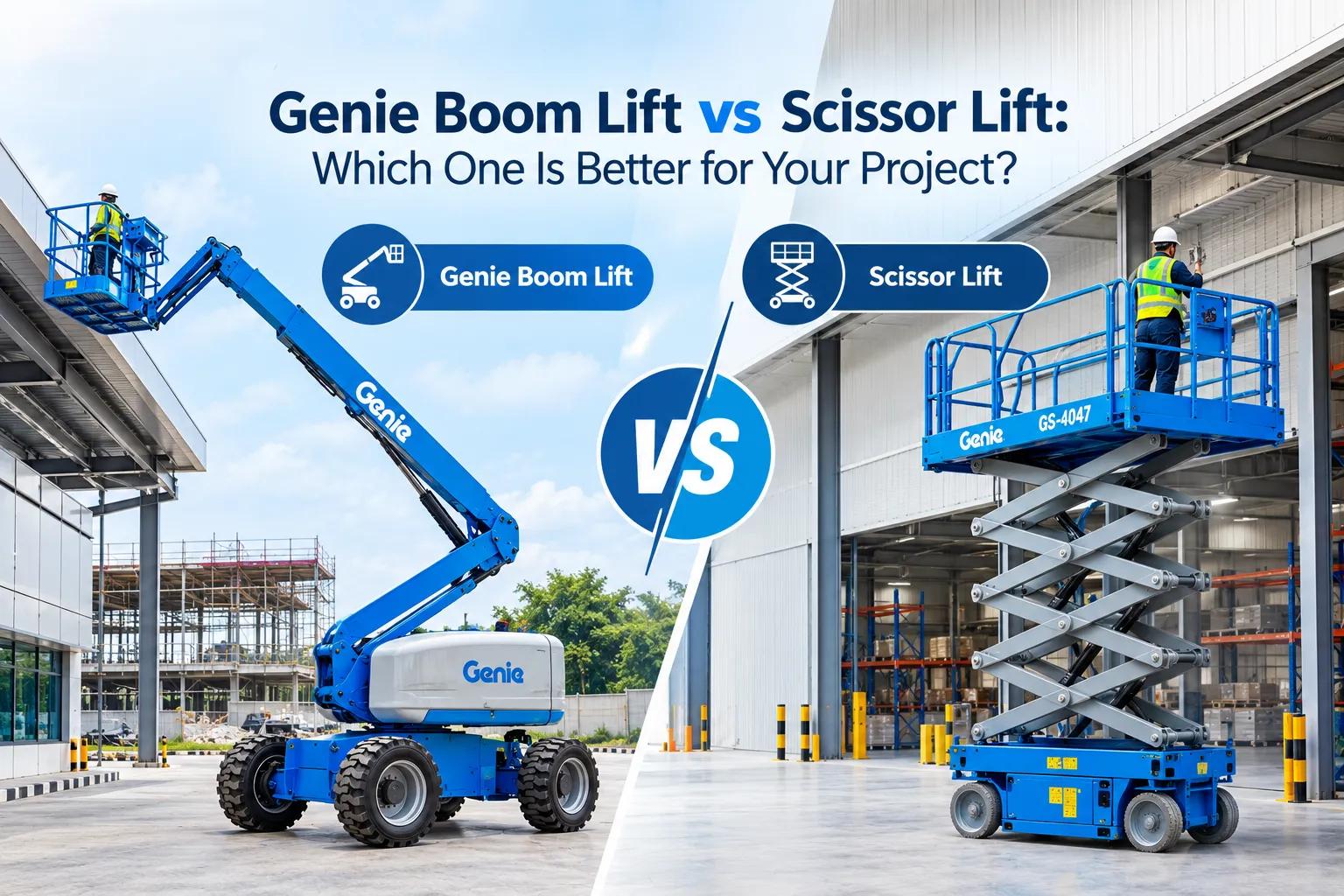
A boom lift provides horizontal outreach and multi-directional movement, making it ideal for working around obstacles at height. A scissor lift moves only vertically, offering a stable, wide platform for tasks directly below the work area. The right choice depends on your job site layout, working height, load requirements, and whether you need lateral reach.
If you're a contractor, site supervisor, or warehouse manager in Malaysia trying to decide between these two types of access equipment, this comparison will help you make a practical, cost-effective decision. Genie boom lifts are a popular choice across construction, maintenance, and industrial sectors but they aren't always the right tool for every job.
What Is a Boom Lift and How Does It Work?
A boom lift is an aerial work platform (AWP) attached to a hydraulic arm that extends both vertically and horizontally. The operator stands in a basket at the end of the arm, which can rotate, articulate, or telescope depending on the model.
There are two main types:
Telescopic boom lifts — straight arms that extend outward for maximum reach
Articulating boom lifts — jointed arms that bend around obstacles
Working heights for boom lifts commonly range from 12 metres to over 40 metres. They're built for outdoor and semi-outdoor environments, with rough-terrain models available for uneven ground on active construction sites.
What Is a Scissor Lift and How Does It Work?
A scissor lift uses a crisscross (scissor) mechanism to raise a platform straight up. It offers no horizontal reach the platform goes up and comes down, period. What it lacks in outreach, it makes up for in platform size and load capacity.
Scissor lifts are widely used in:
Warehouse shelving and inventory work
Indoor ceiling maintenance and electrical work
Retail and logistics facility fit-outs
Floor-level construction tasks requiring a stable elevated platform
Electric scissor lifts are especially common indoors because they produce zero emissions and operate quietly. Rough-terrain diesel models are available for outdoor use.
Boom Lift vs Scissor Lift: Direct Comparison
Here's a side-by-side look at the key differences to help you decide quickly:
Feature | Boom Lift | Scissor Lift |
|---|---|---|
Movement | Vertical + horizontal outreach | Vertical only |
Max Working Height | Up to 40m+ | Typically up to 14–18m |
Platform Size | Smaller basket | Large, wide platform |
Load Capacity | Lower (1–2 workers + tools) | Higher (multiple workers + materials) |
Best Environment | Outdoor, construction, elevated facades | Indoor, warehouses, flat surfaces |
Manoeuvrability | High — reaches over obstacles | Limited — must be positioned directly below |
Terrain Handling | 4WD rough-terrain models available | Primarily flat, hard surfaces |
Scissor Lift Rental Cost (Malaysia) | Higher daily rate | Generally more affordable |
When Should You Choose a Genie Boom Lift?
Choose a boom lift when your task requires reaching over, under, or around obstructions not just straight up. This is where boom lifts genuinely outperform every other access solution.
Ideal Use Cases for Boom Lifts
Building facade maintenance — cleaning, painting, or inspecting exterior walls where direct positioning isn't possible
Structural steel installation — reaching across beams and trusses on active construction sites
Bridge and infrastructure inspection — articulating arms can position workers at precise angles
Tree trimming and utility work — irregular terrain and overhead obstacles are common
Oil and gas facility maintenance — reaching equipment in confined or elevated spaces
In Malaysia's construction sector, boom lifts are frequently deployed on high-rise projects in the Klang Valley and on industrial plant maintenance work in Johor and Penang. Their ability to handle uneven ground with 4WD rough-terrain configurations makes them practical across the country's diverse project environments.
When Should You Choose a Scissor Lift?
A scissor lift is the smarter, more economical choice when your work is directly overhead and your surface is flat and stable. For indoor projects especially, it's hard to justify a boom lift's cost and size.
Ideal Use Cases for Scissor Lifts
Warehouse racking installation — wide platforms carry multiple workers and materials simultaneously
HVAC and electrical fit-outs — indoor ceiling work on commercial and industrial buildings
Retail store refits — compact electric models fit through standard doorways
Airport and mall maintenance — zero-emission electric units are approved for enclosed public spaces
Scissor lift rental is popular among Malaysian contractors handling fit-out and renovation work, particularly in shopping complexes, logistics hubs, and manufacturing facilities where ceiling heights are consistent and surfaces are even.
Key Factors to Consider Before Making Your Decision
1. Working Height Required
If your project exceeds 18 metres, a boom lift is almost certainly your only practical option. Scissor lifts peak well below the heights that boom lifts can achieve.
2. Horizontal Reach Needed
This is the clearest differentiator. If you can position the machine directly below the work area every time, a scissor lift is sufficient. The moment you need outreach to reach over a wall, across a beam, or into a recessed area you need a boom lift.
3. Site Surface Conditions
Scissor lifts are designed for firm, level surfaces. On rough ground, slopes, or unprepared terrain, a rough-terrain boom lift is not just more suitable it's safer. The Department of Occupational Safety and Health (DOSH) Malaysia enforces strict guidelines under the Factories and Machinery Act for the use of aerial work platforms, and selecting equipment appropriate for the terrain is a compliance requirement, not a suggestion.
4. Number of Workers and Load
If your task requires two to four workers plus materials on the platform at the same time, a scissor lift's larger deck is more practical. Boom lift baskets are compact by design typically suited for one to two operators with hand tools.
5. Indoor vs Outdoor Environment
Electric scissor lifts are the preferred choice indoors due to their zero-emission operation. Diesel-powered boom lifts are better suited for outdoor environments where ventilation is not a concern.
Genie Boom Lifts Services: What to Look for in a Provider
Whether you're renting or purchasing, the quality of your genie boom lifts services matters as much as the equipment itself. Key things to look for include:
A fleet of well-maintained, regularly serviced machines
Operators certified and trained under DOSH-recognised programmes
On-site technical support and breakdown response
Flexible rental durations — daily, weekly, or project-based
Equipment matched specifically to your job site conditions
Poorly maintained equipment is one of the leading causes of aerial work platform incidents on Malaysian construction sites. Always verify service records and operator training documentation before committing to a rental or purchase agreement.
Which Is the Better Choice for Your Project?
There's no universal winner in the boom lift vs scissor lift debate. The right equipment is the one matched precisely to your job requirements.
Choose a boom lift if you need height beyond 18 metres, horizontal outreach, or rough-terrain capability.
Choose a scissor lift if your work is directly overhead, on flat ground, indoors, and requires a wide platform for multiple workers.
Forcing the wrong machine onto a job site costs time, money, and most importantly compromises worker safety. Matching your equipment to the task is a fundamental part of competent project planning.
For contractors and site managers across Malaysia looking for reliable access equipment, BES Industry & Trading Sdn Bhd. offers a comprehensive range of boom lifts, scissor lifts, and related aerial work platform solutions tailored to local project demands. Their team can help assess your site conditions and recommend the most appropriate equipment for the job.
FAQ: Boom Lift vs Scissor Lift
What is the main difference between a boom lift and a scissor lift?
A boom lift provides both vertical and horizontal reach through an extendable arm, while a scissor lift moves only straight up and down. Boom lifts are suited for reaching over obstacles; scissor lifts are better for large, flat working surfaces directly below the task.
Which is safer a boom lift or a scissor lift?
Both are safe when used correctly and within their rated capacities. Scissor lifts offer greater platform stability for multiple workers, while boom lifts carry higher risk of tip-over if overloaded or used on uneven ground. Always follow DOSH Malaysia safety guidelines for aerial work platforms.
Is scissor lift rental cheaper than boom lift rental in Malaysia?
Yes, scissor lift rental is generally more affordable than boom lift rental in Malaysia. The cost difference reflects the boom lift's greater technical complexity, outreach capability, and terrain versatility. For budget-sensitive indoor projects, a scissor lift is the more economical option.
Can a boom lift be used indoors?
Electric boom lifts can be used indoors as they produce no emissions. However, their size and turning radius make them less practical than scissor lifts for most indoor environments. Always confirm ceiling height clearance and floor load ratings before deploying any boom lift inside a building.
What working height do I need a boom lift for?
A boom lift is typically recommended when working heights exceed 18 metres or when horizontal outreach is required. For heights below 14 metres with direct overhead access on a flat surface, a scissor lift is usually sufficient and more cost-effective.
Do I need a certified operator to use genie boom lifts in Malaysia?
Yes. Under DOSH Malaysia regulations, operators of aerial work platforms including genie boom lifts must hold a valid competency certificate. Always ensure your operator is trained and certified before commencing any elevated work to comply with the Factories and Machinery Act.